Home  |  Contact

Content on this page requires a newer version of Adobe Flash Player.

Get Adobe Flash player


Media > Drama Logue


The Vision Thing - The actor's way by Karen Kondazian


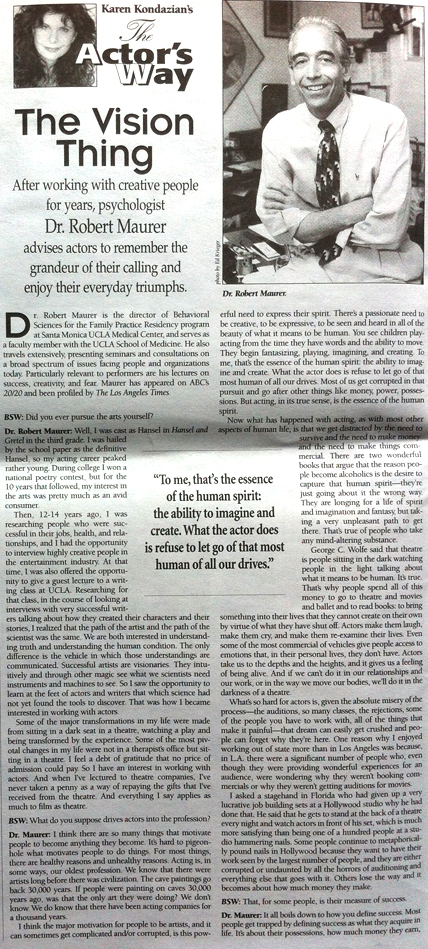
The Vision ThingAfter working with creative people for years, psychologist Dr. Robert Maurer advises actors to remember the grandeur of their calling and enjoy their everyday triumphs.

Dr. Robert Maurer is the director of Behavioral Sciences for the Family Practice Residency program at Santa Monica UCLA Medical Center, and serves as a faculty member with the UCLA School of Medicine. He also travels extensively, presenting seminars and consultations on a broad spectrum of issues facing people and organizations today. Particularly relevant to performers are his lectures on success, creativity and fear. Maurer has appeared on ABC's 20/20 and been profiled by The Los Angeles Times.

BSW: Did you ever pursue the arts you

Dr. Robert Maurer: Well, I was cast as Hansel in Hansel and Gretel in the third grade. I was hailed by the school paper as the definitive Hansel, so my acting career peaked rather young. During college I won a national poetry contest, but for the 10 years that followed, my interest in the arts was pretty much as an avid consumer.

Then, 12-14 years ago, I was researching people who were successful in their jobs, health, and relationships, and I had the opportunity to interview highly creative people in the entertainment industry. At that time, I was also offered the opportunities to give a guest lecture to a writing class at UCLA. Researching for that class, in the course of looking at interviews with very successful writers talking about how they created their characters and their stories, I realized that the path of the artist and the path of the scientist was the same. We are both interested in understanding truth and understanding the human condition. The only difference is the vehicle in which those understandings are communicated. Successful artists are visionaries. They intuitively and through other magic see what we scientists need instruments and machines to see. So I saw the opportunity to learn at the feet of actors and writers that which science had not yet found the tools to discover. That was how I became interested in working with actors.

Some of the major transformations in my life were made from sitting in a dark seat in a theatre, watching a play and being transformed by the experience. Some of the most pivotal changes in my life were not in a therapist's office but sitting in a theatre. I feel a debt of gratitude that no price of admission could pay. So I have an interest in working with actors. And when I've lectured to theatre companies, I've never taken a penny as a way of repaying the gifts I've received from the theatre. And everything I say applies as much to film as theatre.

BSW: What do you suppose drives actors into the profession?

Dr. Maurer: I think there are so many things that motivate people to become anything they become. It's hard to pigeonhole what motivates people to do things. For most things, there are healthy reasons and unhealthy reasons. Acting is, in some ways, our oldest profession. We know that there were artists long before there was civilization. The cave paintings go back 30,000 years. If people were painting on caves 30,000 years ago, was that the only art they were doing? We don't know. We do know that them have been acting companies for a thousand years.

I think the major motivation for people to be artists, and it can sometimes get complicated and/or corrupted, is this powerful need to express their spirit. There's a passionate need to be creative, to be expressive, to be seen and heard in all of the beauty of what it means to be human. You see children playacting from the time they have words and the ability to move. They begin fantasizing, playing, imagining, and creating. To me, that's the essence of the human spirit: the ability to imagine and create. What the actor does is refuse to let go of that most human of all our drives. Most of us get corrupted in that pursuit and go after other things like money, power, possessions. But acting, in its true sense, is the essence of the human spirit.

Now what has happened with acting, as with most other aspects of human life, is that we get distracted by the need to survive and the need to make money and the need to make things commercial. There are two wonderful books that argue that the reason people become alcoholics is the desire to capture that human spirit-they're just going about it the wrong way. They are longing for a life of spirit and imagination and fantasy but taking a very unpleasant path to get there. That's true of people who take any mind-altering substance.

George C. Wolfe said that theatre is people sitting in the dark watching people in the light talking about what it means to be human. It's true. That's why people spend all of this money to go to theatre and movies and ballet and to read books: to bring something into their lives that they cannot create on their own by virtue of what they have shut off. Actors make them laugh, make them cry, and make them reexamine their lives. Even some of the most commercial of vehicles give people access to emotions that, in their personal lives, they don't have. Actors take us to the depths and the heights, and it gives us a feeling of being alive. And if we can't do it in out relationships and our work, or in the way we move our bodies, we'll do it in the darkness of a theatre.

What's so hard for actors is, given the absolute misery of the process - the auditions, so many classes, the rejections, some of the people you have to work with, all of the things that make it painful---that dream can easily get crushed and people can forget why they're here. One mason why I enjoyed working out of state more than in Los Angeles was because, in L.A. there were a significant number of people who, even though they were providing wonderful experiences for an audience, were wondering why they weren't booking commercials or why they weren't getting auditions for movies.

I asked a stagehand in Florida who had given up a very job building sets at a Hollywood studio why he had done that. He said that he gets to stand at the back of a theatre every night and watch actors in front of his set, which is much more satisfying than being one of a hundred people at a studio hammering nails. Some people continue to metaphorically pound nails in Hollywood because they want to have their work seen by the largest number of people, and they are either corrupted or undaunted by all the horrors of auditioning and everything else that goes with it. Others lose the way and it becomes about how much money they make.

BSW: That, for some people, is their measure of success.

Dr. Maurer: It all boils down to how you define success. Most people get trapped by defining success as what they acquire in life. It's about their possessions, how much money they earn, their titles, their credits. I think it's even more problematic for an actor because, unlike any other profession I know, the more success you have, the more you have a momentum that continues unabated. As a psychologist, for example, you just assume that once you have established a reputation or competence, even though you will continue to grow and work, basically your future is ordained. That's true for most professions. In acting, one success is no guarantee that you'll get another job, let alone continued success.

There was a 20-year study of painters in Chicago. They looked at people beginning in their graduate training in art, through their training, to what happened to them. They looked at one thing: those who loved school, who just enjoyed painting and the process, and those who were tolerating school and making the best of a difficult situation in the hopes that they would someday paint in a way that would be recognized with fame and fortune. The only people still painting 20 years later were those who loved painting and the process.

Painting, like acting or writing or dancing, is such a difficult task The rewards are so infrequent, and when they come, when you win the prize, when you get the acclaim, it can be very intense, but those moments are still few and far between, given the number of hours, weeks, and months of work there is between those epic events. The people who love their craft and see themselves as artists, and carry that identity through and study each day, who use walking down the street as a place to study and observe, who absorb every person they meet because they don't know when that person might show up in an artistic endeavor, are the people who thrive. To me, that's the only definition of success that matters.

I've worked with some of the most commercially successful artists in the world. Some of them are happy and some of them are miserable. The misery they had before they became an artist simply carried through. All the fame and fortune doesn't erase someone's unhappiness. That's the bottom line in terms of success. Successful people are able to sustain their identity as separate from their profession and what's happening to them. That's particularly important in the arts, where what happens to you bears only faint correlation to your talent. There are so many people who we worship as great artists who, in their lifetime, received nothing. Herman Melville only sold 5,000 copies of Moby Dick in his lifetime. Unless you're taking joy in the pursuit of it, you're better off doing something else.

An actor's life can be so miserable with all of its obstacles. But as an actor or a mother or a tollbooth operator, it's the same challenge, which is, how do I learn to take joy in this moment? Most of us are convinced that if we could only have something outside of ourselves, we'd be happy. We want the right relationship, the right job, enough money. It's the same tragic error that we all make, and actors have a harder time overcoming it because the environment is so punishing. Even working actors, because once you make a project, you're at the mercy of everybody. I heard a review of a movie on the radio this morning, and it just trashed an actor for two minutes. Most of us don't have to deal with that. My mistakes are made within the privacy of an office.

BSW: What's your advice to actors who put the rest of their lives "on hold" in pursuit of their careers?

Dr. Maurer: The only reason we want to be successful and on a series making a lot of money is we think that that's what's going to make us happy We're all striving to be happy. What we lose along the way is the realization that we can all create that happiness, even in the face of all of these adversities. Human beings are capable of it. That's why we are amazed by the Mother Theresas and Christopher Reeves and Nelson Mandelas of the world: They can live amidst pain, poverty, imprisonment, and still find a way to create their own beauty. They are, if you will, artists. They create their own beauty in an environment where it doesn't exist. They make their own stage. The actor simply made that his or her life's work, which is the most grand thing a human can do, but the grandeur or it can easily get lost when one is trying to jpay the rent or the car insurance.

BSW: Do you favor any techniques to help people focus on the moment?

Dr Maurer: There's a couple of way to do it. The easiest way is to find "teachers," and thay aren't easy to find. You want teachers in any venue who are examples of people enjoying their life today. Some of them will be doing what people might call a menial job, yet some of them are taking great pride and pleasure in their position. You need teachers in life who are taking pleasure in today so that you have a constant reminder of what's possible.

Another technique we recommend is to do volunteer work with people who are struggling. One of the tradegies of the human mind is that we forget how lucky we are. Even an unemployed actor has at least found their life's dream, is living in a democracy, and probably has their health. No matter how miserable out lives are during periods of rejection and bleakness, by comparison, we are wealthy beyond means. There's so much we have to be grateful for, and unfortunately, we're just not wired for gratitude. The experience is to remind yourself how lucky you are to have found your craft and to have the freedom to pursue it even if that pursuit can be painful.

The third thing is having someone ask you, "What do you have to be grateful about right now? What are you enjoying right now?" One of the things we've discovered about the human brain is that it doesn't store everything that's happened to you; it stores what it uses. If you go through the day saying, "What's wrong with me? Why can't I get a break,? Why can't I lose weight?" the brain doesn't have the capacity to say "Hey, that's not fair. Those are ugly questions, and I refuse to listen to you talk to me that way" Instead, the brain is forced to start looking for answers and will start storing columns of cells about every weakness, flaw, or mistake it can remember. It got all of that stuff stored, whereas all of the positive stuff gets no storage because you don't go around saying, "What am I happy about? What's great about today? What do I love about being an actor?" Now, those questions may sound kind of sappy, but the reason you want to practice saying them out loud is so that the brain gets used to storing information that relates to what you're grateful for and happy about.

Christopher Reeve when he was interviewed by Barbara Walters, acknowledged, all of the pain and suffering he went through but also said that he realized I how lucky he was. We are all capable of, in the face of adversity celebrating how lucky we are. Reeve focuses his mind and knows that he has the potential to control and shift the emotional experience, no matter the circumstances. That's what art is all about: the ability to shift one's perceptions of things. When you go to the theatre, you're going to have your emotional experience shifted. You're just paying somebody to do it for you.

BSW: Do you have any final tips for the actor?

Dr. Maurer: I've worked with people in countless different professions. The most heroic of life's paths is that of the creative artist. There is nothing that fulfills the human experience more. There are other animals that work together, that use tools, that have language. The only thing that anthropologists have found that separates humans from other animals is our ability to create our own beauty. There is no art that we've discovered among any other species. The only thing worthwhile in having an animal as complicated, difficult, and potentially destructive to itself and the planet as the human being is its potential to create art. The only people on the planet risking that path, attempting to fulfill the God-given gifts of being human, are the artists.

There are two tragedies in the artist's life as far as I'm concemed. Firstly. the artist doesn't appreciate how grand and
heroic the path is. He or she takes the most difficult and gallant road on the planet, and then feels bad if it's not commercially successful. The second is how artists are treated in the world. It's not recognized that they are essentially our spiritual leaders. They are providing what religion attempts to provide. We dearly hope that they will entertain us and give us fight and show us the way. BSW

To learn more about Robert Maurer's programs for actors and writers, you may contact him at:

1223 Wilshire Blvd., #415
Santa Monica CA 90403
(310) 393-8051


Your Location: Home > Media > Drama Logue